
Science Snapshot - Fruit flies (Drosophila melanogaster) as a model for human health and disease
Author: Mimi Aziz, PhD Candidate (Chow Lab, University of Utah), CSNK2A1 Foundation Intern
Editors: Dr. Gabrielle Rushing, CSNK2A1 Foundation Chief Scientific Officer and Dr. Caroline Bodnya, CSNK2A1 Foundation Research Associate
CSNK2A1 Foundation Parent Advisory Board Reviewers: Claire Whitehill and Michelle Proctor-Simms
Odds are, you’re familiar with the tiny fruit flies that invade your kitchen and hover around overripe bananas. They may seem like little more than a household nuisance, but these unassuming insects are also powerful tools for studying human disease.
Scientists have used the common fruit fly, Drosophila melanogaster, to study genetics for more than a century. Fruit flies are inexpensive to maintain, reproduce quickly, and can be genetically modified with relative ease. These qualities have made them useful for studying topics ranging from development and aging to cancer and neurological disorders.
Similarities to humans: At first glance, fruit flies may seem to have little in common with humans. At the genetic level, however, the similarities are surprisingly extensive. The fruit fly genome1 is relatively small, containing about 180 million base pairs2, far fewer than the roughly 3.2 billion found in the human genome. Its smaller size makes the fly genome more manageable for researchers to study and manipulate. Despite this difference in size, about 60% of human genes have a similar gene (referred to as a homolog) in fruit flies. Approximately 75% of genes associated with human disease also have a related gene in the fly.
Fruit flies even have a surprisingly complex nervous system. Although it is much smaller than the human nervous system, it uses many of the same basic cellular pathways, making the fly especially useful for studying brain development and neurodevelopmental disorders.
Tools for fruit fly research: Researchers can use sophisticated genetic tools to change a gene in fruit flies and observe how that change affects an entire living organism. Scientists can switch genes off, reduce their activity, or make them more active. They can also control where and when these changes occur, for example, changing a gene only in the brain, or only during a particular stage of development.
Because genes that cause disease in humans have close matches in fruit flies, scientists can also recreate a patient’s genetic change in a fly and observe what happens. Two tools make this possible:
- The GAL4/UAS system lets researchers turn a gene on or off in just one part of the fly’s body, such as the brain.
- CRISPR/Cas9 works like molecular scissors, letting researchers edit a specific spot in the fly’s DNA, even creating the exact change found in a patient.
Why this is important for genetic disorders: Scientists can study how a change in a single gene, such as CSNK2A1, affects the fly’s behavior and biological processes throughout the body. In this way, flies can offer valuable clues about what happens in human disease.
Fruit flies can also help scientists search for ways to treat a disease. In one approach, known as drug repurposing, researchers can test large collections of existing medicines to identify new uses for them. Because these medicines have already been tested for safety in humans, a promising result in flies may move toward clinical testing more quickly than a brand-new drug.
In another approach, called a genetic modifier screen, researchers look for changes in other genes that make a disease milder or more severe. A genetic modifier is a natural genetic change that doesn’t cause a disease on its own but can influence the severity of a disease.
Together, drug repurposing and genetic modifier screens help uncover how a disease works and highlight promising directions for future development of treatments. Because fruit flies live for only a few weeks and produce a new generation in about 10 days, scientists can run these tests quickly and study many generations in a short time. This speed allows researchers to explore many therapeutic possibilities early on and potentially trial them in patients. This speed matters for rare diseases, many of which still lack effective treatments.
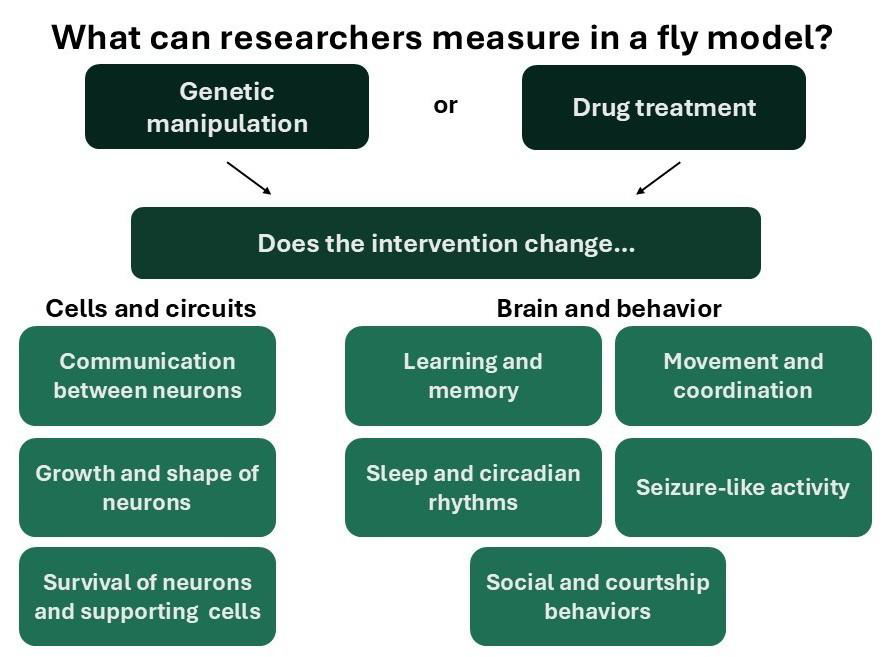
Models of Human Neurodevelopmental Disorders in fruit flies
The brain is made up of nerve cells called neurons, which pass messages to each other through connection points called synapses. Many of the genes that build and maintain these connections are shared between flies and humans. Because of this, fruit flies have been especially useful for studying neurodevelopmental disorders. Over the years, researchers have developed fruit fly models of various neurodevelopmental disorders to study how a given disorder changes the way that neurons grow and communicate. Some examples are highlighted below.
Fragile X: Fragile X syndrome is a genetic condition and the most common inherited cause of intellectual disability. FMRP is the protein that is missing in Fragile X syndrome, and flies lacking their version of FMRP develop abnormal neural connections and problems with learning and memory. FMRP normally helps control neuronal growth and remove unnecessary branches as brain circuits mature. These results showed how losing FMRP may disrupt the development and fine-tuning of neural connections.
Angelman syndrome: Angelman syndrome is a genetic condition that affects movement, speech, and sleep. Flies lacking the fly version of the UBE3A protein show changes in movement, learning, sleep, and communication between neurons. Researchers found that UBE3A helps control synaptic growth and allows neurons to recycle materials they need to send signals. These findings provided new insight into how the loss of UBE3A may affect brain development and function.
SHANK-related autism: Changes in SHANK genes are linked to autism spectrum disorder; changes in SHANK3 are linked to Phelan-McDermid syndrome. Fly models showed that loss of the Shank protein disrupts the organization and maturation of synapses, the connections through which neurons communicate. Researchers also linked Shank to a critical developmental pathway called Wnt signaling. This work showed that Shank helps coordinate both the structure of synapses and the signals required for them to develop normally.
PIGA-Congenital Disorder of Glycosylation: In this condition, cells cannot properly attach certain sugar-based anchors that hold proteins on the cell surface. Flies with lower PIGA levels develop seizures and movement problems similar to symptoms seen in patients. Using these flies, researchers identified the fly version of CNTN2 as a gene that can modify disease severity. They also found that changing dopamine signaling improved developmental, movement, and seizure-related problems in the flies. Together, these findings highlight biological pathways for further investigation as potential therapeutic targets.
Modeling Okur-Chung Neurodevelopmental Syndrome in fruit flies
Okur-Chung Neurodevelopmental Syndrome (OCNDS) is caused by changes in the CSNK2A1 gene. Humans have two closely related genes, CSNK2A1 and CSNK2A2, that produce the catalytic, or active, portion of the CK2 protein complex. The CK2 complex works like a cellular control switch. It adds small chemical tags to other proteins, helping regulate essential processes such as cell growth, stress responses, and communication between cells. Fruit flies have only one equivalent gene, called CkIIα (casein kinase II alpha), which is thought to perform the functions of both human genes. Because the human and fly genes perform similar functions, researchers can use fruit flies to investigate how modified CkIIα activity affects development and behavior. With one gene doing the work of both human genes, flies can offer a clearer view of what happens when CK2 activity is disrupted.
Researchers were studying the effects of altered CK2 activity in flies well before it was linked to OCNDS. In one study, reducing CK2 activity in the neurons that control the fly’s internal clock greatly lengthened its daily activity cycle, disrupting its circadian rhythm. This work showed that CK2 plays an important role in regulating behavior and development.
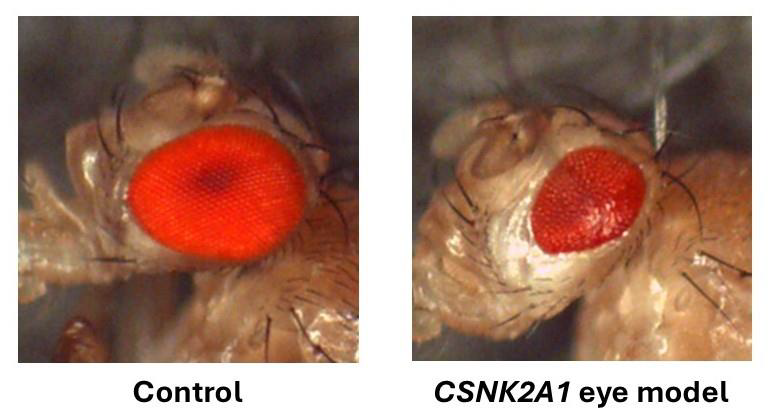
Building on this understanding of CK2 in flies, researchers in Dr. Clement Chow’s lab developed a fruit fly model of OCNDS by reducing CkIIα specifically in the developing eye. This results in a smaller-than-normal eye, providing a visible and measurable feature that can be used to test potential treatments. A drug that increases eye size may improve the underlying developmental defect. In contrast, one that makes the eye smaller may worsen it. If several drugs targeting the same biological pathway show similar results, that pathway may offer an important clue about the biology of OCNDS.
Example of a fly model of OCNDS, where CkIIα
gene expression (the fly version of CSNK2A1) is reduced only in the eye:
Dr. Chow’s lab used this model to screen more than 1,500 compounds, most of which are already approved by the Federal Drug Administration or European Medicines Agency. For each drug, they asked a straightforward question: does it improve the development of the fly’s eye? The answer can reveal more than whether a single drug is beneficial. By examining what the most promising drugs have in common, researchers can identify biological pathways that may contribute to OCNDS and uncover directions for future treatments.
Who would have thought that the next clue for treating human disease might be circling around your fruit bowl?
1 Genome: The complete set of DNA instructions in an organism.
2
Base pairs: Complementary DNA building blocks that link together to form the “rung” of the DNA ladder.
References
- Bellen HJ, Tong C, Tsuda H. 100 years of Drosophila research and its impact on vertebrate neuroscience: a history lesson for the future. Nat Rev Neurosci 2010;11:514–22. https://doi.org/10.1038/nrn2839.
- Rubin GM, Yandell MD, Wortman JR, Gabor Miklos G,L., et al. Comparative genomics of the eukaryotes. Science 2000 Mar 24;287(5461):2204-15.
- Reiter LT, Potocki L, Chien S, et al. A systematic analysis of human disease-associated gene sequences in Drosophila melanogaster. Genome Res 2001;11:1114–25. https://doi.org/10.1101/gr.169101.
- Tessier CR, Broadie K. Drosophila fragile X mental retardation protein developmentally regulates activity-dependent axon pruning. Development 2008;135:1547–57. https://doi.org/10.1242/dev.015867.
- Wu Y, Bolduc FV, Bell K, et al. A Drosophila model for Angelman syndrome. Proc Natl Acad Sci U S A 2008;105:12399–404. https://doi.org/10.1073/pnas.0805291105.
- Li W, Yao A, Zhi H, et al. Angelman Syndrome Protein Ube3a Regulates Synaptic Growth and Endocytosis by Inhibiting BMP Signaling in Drosophila. PLoS Genet 2016;12:e1006062. https://doi.org/10.1371/journal.pgen.1006062.
- Harris KP, Akbergenova Y, Cho RW, et al. Shank Modulates Postsynaptic Wnt Signaling to Regulate Synaptic Development. J Neurosci 2016;36:5820–32. https://doi.org/10.1523/JNEUROSCI.4279-15.2016.
- Thorpe HJ, Owings KG, Aziz MC, et al. Drosophila models of phosphatidylinositol glycan biosynthesis class A congenital disorder of glycosylation (PIGA-CDG) mirror patient phenotypes. G3 (Bethesda) 2024;14:jkad291. https://doi.org/10.1093/g3journal/jkad291.
- Thorpe HJ, Pedersen BS, Dietze M, et al. Identification of CNTN2 as a genetic modifier of PIGA-CDG in a family with incomplete penetrance and in Drosophila. Am J Hum Genet 2025;112:572–82. https://doi.org/10.1016/j.ajhg.2025.01.017.
- Aziz MC, Wilson J, Chow CY. A drug repurposing screen reveals dopamine signaling as a candidate therapeutic pathway for PIGA-CDG. PLoS Genet 2026;22:e1012294. https://doi.org/10.1371/journal.pgen.1012294.
- Smith EM, Lin J-M, Meissner R-A, et al. Dominant-negative CK2alpha induces potent effects on circadian rhythmicity. PLoS Genet 2008;4:e12. https://doi.org/10.1371/journal.pgen.0040012.