
Science Snapshot - Rett Syndrome and Okur-Chung Neurodevelopmental Syndrome: Shared Insights Across Rare Disorders
Author: Monica Strain, PhD, Research Fellow, Department of Neurosurgery, Boston Children’s Hospital
Edited by:
- Gabrielle Rushing, PhD, Chief Scientific Officer, CSNK2A1 Foundation
- Carly Krull, PhD, Former CSNK2A1 Foundation Intern
- Ashley Anderson, PhD, Postdoctoral Associate, Lab of Dr. Huda Zoghbi, Department of Molecular and Human Genetics, Baylor College of Medicine
CSNK2A1 Foundation Parent Advisory Board Reviewers: Katie Keiser and Terri Jordan
Although Rett syndrome (RTT) and Okur-Chung Neurodevelopmental Syndrome (OCNDS) are caused by mutations in different genes, both are rare neurodevelopmental disorders that affect how the brain develops and functions. Learning from one condition can often shed light on the other, underscoring the interconnected nature of rare disease research. This Science Snapshot highlights the similarities and differences between RTT and OCNDS.
Different Genes and Underlying Causes:
RTT is primarily caused by loss-of-function mutations in the MECP2 gene, located on the X-chromosome. The MECP2 gene encodes the MeCP2 protein, a key regulator of gene expression. MeCP2 works like a light switch, turning other genes on or off at the right times to keep gene activity balanced. This balance is important because it helps ensure that neurons develop properly and communicate effectively. When MECP2 is mutated and MeCP2 no longer works correctly, the typical light switch function is broken. Some genes may be too active, while others are not active enough. This imbalance can disrupt normal neuronal development and interfere with how neurons communicate with each other.
OCNDS is caused by heterozygous mutations in the CSNK2A1 gene on chromosome 20. This gene encodes casein kinase 2 alpha (CK2α), which is an enzyme that helps regulate many other proteins in the cell. Instead of acting like a simple on/off switch, CK2α works more like a control panel, fine-tuning how different proteins behave and communicate. It does this by adding small chemical “tags” (called phosphate groups) that help proteins do their jobs properly. Because CK2α influences many pathways, changes in this gene can affect multiple systems at once. When CSNK2A1 is mutated, this control panel becomes disrupted, and important cellular processes, especially those involved in neuronal development and signaling, do not function as they should.
Both
MECP2 and
CSNK2A1 are essential for maintaining balanced gene and protein activity within the body. Disruptions in either gene can interfere with normal development and communication between cells. In most individuals, these genetic changes occur spontaneously (de novo) rather than being inherited, although rare familial cases of RTT and OCNDS have been reported.
Common Features and Shared Challenges:
Despite their different genetic causes, RTT and OCNDS share several symptoms and challenges that affect development, communication, and movement.
Main Features of OCNDS:
- Speech delay or limited speech
- Developmental delays and mild-to-moderate intellectual disabilities
- Low muscle tone (hypotonia)
- Feeding difficulties
- Sleep disturbances
- Distinctive facial features
- Behavioral challenges
- Autism
- Seizures (in ~33% of individuals)
- Microcephaly
Main Features of RTT:
- Developmental delays
- Loss of purposeful hand use
- Loss of spoken language with limited nonverbal communication skills
- Autism
- Behavioral challenges
- Seizures (in ~70-90% of individuals)
- Breathing abnormalities
- Feeding difficulties
- Parkinsonian features
- Microcephaly
- Sleep disturbances
- Cardiorespiratory abnormalities
Shared clinical features
- Developmental delay and intellectual disability
- Speech difficulties
- Behavioral issues, including autism-spectrum disorder and stereotypic movements
- Seizures
- Disrupted sleep patterns
- Abnormal head size (microcephaly)
- Musculoskeletal problems
Understanding these overlaps can help researchers understand why certain features appear in both conditions and may one day guide new treatment strategies that benefit multiple rare syndromes.
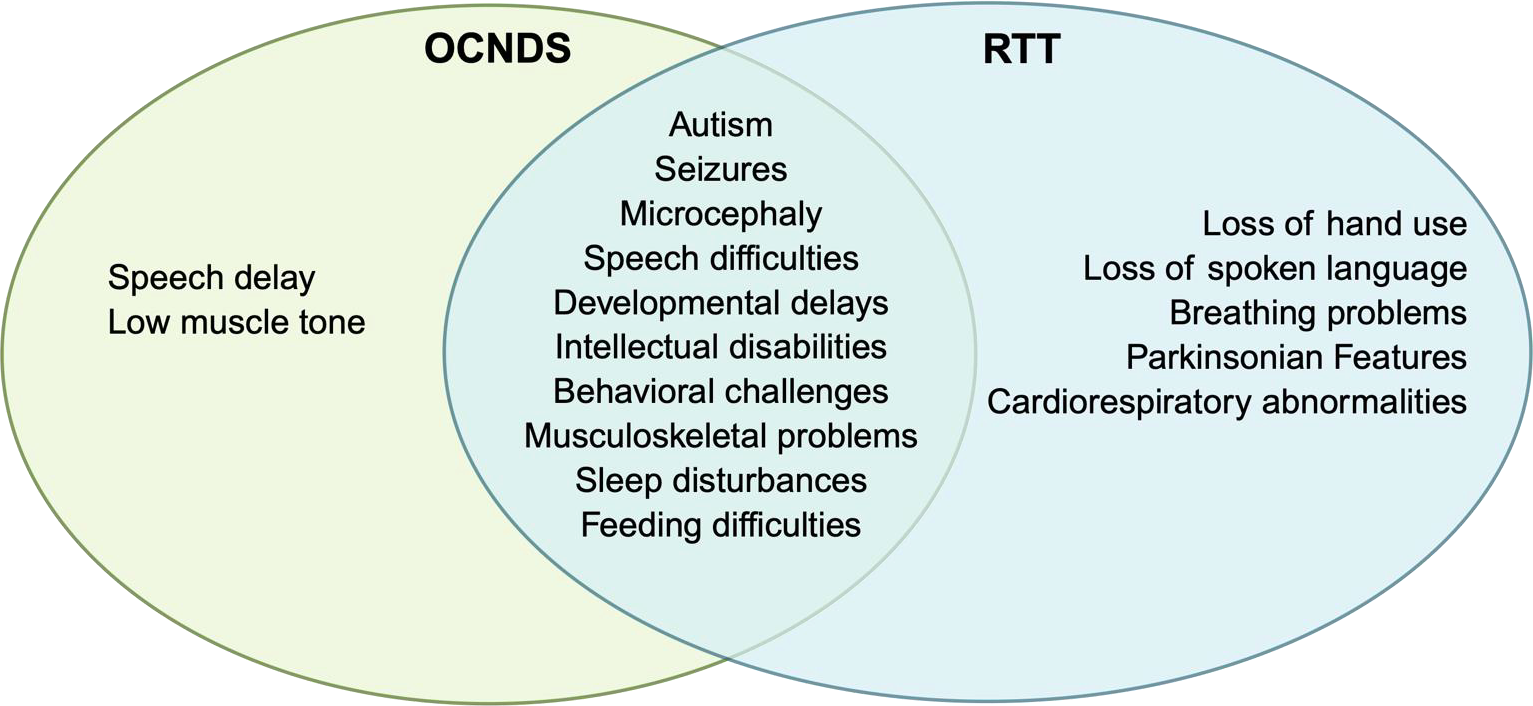
This figure shows shared and distinct symptoms between OCNDS and RTT. On the left in green are symptoms present in OCNDS, in the middle shared space between both colored circles are symptoms that present in both OCNDS and RTT, and in blue on the right are unique symptoms to RTT.
Figure created with BioRender.
How the Conditions Progress
RTT is a progressive neurodevelopmental disorder, meaning that symptoms develop gradually and can worsen over time. Most children with RTT develop typically for the first 6-18 months of life before signs of developmental regression begin to appear. Researchers have described RTT as manifesting in four stages:
- Early onset stable: Subtle developmental delays may start to appear.
- Rapid regression phase: Children may lose skills they had previously gained such as purposeful hand use or spoken language. Stereotypical hand movements, seizures, respiratory problems, and unstable walking may also begin to appear.
- Plateau phase: Symptoms often stabilize during period, though motor difficulties and seizures may become more common.
- Late motor deterioration stage: Over time, mobility becomes limited, and many individuals develop severe physically disabilities that often require the use of a wheelchair.
In contrast, OCNDS is not considered a progressive disorder. Children with OCNDS may experience developmental delays early in life, but many individuals continue to learn, grow, and achieve new milestones over time.
Emerging Scientific Connections
Exciting new research suggests that the CSNK2A1 and MECP2 genes may share important similarities. A 2023 study led by Dr. Bowei Kang (University of Chicago) found that these two genes share a similar way of being regulated during brain development. Specifically, both genes use cell-type-specific polyadenylation (PA) signals, which act like genetic “stop signs” that help determine how a gene’s message is completed and used by cells.
This discovery demonstrates that these PA signals vary across different types of brain cells, suggesting that CSNK2A1 and MECP2 may produce different versions of their genetic messages depending on the cell type. This shared regulatory feature suggests that both genes may be shaped by similar biological processes during brain development.
Because OCNDS and RTT share many overlapping symptoms, these findings raise the possibility that the two conditions may involve shared molecular mechanisms, including those related to PA signal regulation. In addition, there is promising unpublished research that further connects
CSNK2A1 and
MECP2, which we hope to share more information about in the future. Understanding how
CSNK2A1 and
MECP2 converge at the biological level may provide valuable insight into treatment targets that may benefit individuals with RTT, OCNDS, or potentially both conditions in the future.
Future directions
Currently, there are no cures for RTT or OCNDS. Most treatments focus on managing symptoms and improving quality of life rather than addressing the root cause of the disease. Even so, the outlook for both communities is becoming increasingly hopeful as research continues to advance.
In 2023, the FDA approved trofinetide (Daybue), the first ever treatment specifically developed for RTT. Trofinetide has demonstrated improvements in communication, hand behaviors, breathing problems, and walking and standing ability in RTT patients. Importantly, this milestone provides a compelling example that targeted therapies can be successfully developed for rare neurodevelopmental disorders can be successfully developed and meaningfully improve patients’ lives. Although there are still no approved therapies for OCNDS, this breakthrough demonstrates what’s possible when science, families, and patient advocacy organizations work together towards a shared goal.
By studying RTT and OCNDS together, researchers are understanding how different genetic changes can lead to similar neurodevelopmental challenges. This side-by-side approach not only helps identify shared biological pathways but also guides the search for new and more effective treatments that could benefit both communities. Each discovery adds to our collective understanding and brings both the scientific and patient communities closer to meaningful progress and therapeutic advances.
Glossary
Loss-of-function mutations: mutations that reduce or eliminate the normal activity of a gene, preventing it from making a working protein.
Gene expression: the regulatory process by which a cell controls when genes are turned on or off and how much of a gene’s product is produced.
Neurons: specialized cells of the central nervous system that send and receive signals to communicate information.
Heterozygous: in the context of a mutation, heterozygous means that a person has one normal copy of a gene and one copy that carries a mutation.
X-chromosome: X chromosome is one of the two sex chromosomes that determine biological sex. Most females have two X chromosomes, while most males have one X and one Y chromosome.
Phosphate groups: Phosphate groups are small groups of atoms made of phosphorus and oxygen. Cells can add or remove phosphate groups from proteins to change how those proteins work, almost like turning a switch on or off.
Phosphorylation: a chemical process in which a small tag called a phosphate group is added to a protein, which can change the protein’s activity or turning it on or off.
De novo: a genetic change that is new and was not inherited from either parent.
Polyadenylation sites: are genetic signals that tell a cell where to end a gene’s message, helping control how that message is processed and used in different cells.
Convergent: This describes genes or biological pathways that act through similar mechanisms, even though they are not the same gene or originally part of the same pathway.
References
1. Belnap, N. et al. Inherited CSNK2A1 variants in families with Okur-Chung neurodevelopmental syndrome. Clinical Genetics 104, (2023).
2. Chahrour, M. & Zoghbi, H. Y. The Story of Rett Syndrome: From Clinic to Neurobiology. Neuron 56, (2007).
3. Chung, W. & Okur, V. Okur-Chung Neurodevelopmental Syndrome. GeneReviews® (1993).
4. Jafari Khamirani, H. et al. Clinical Features of Okur-Chung Neurodevelopmental Syndrome: Case Report and Literature Review. Molecular Syndromology 13, (2022).
5. Kang, B. et al. Infernape uncovers cell type–specific and spatially resolved alternative polyadenylation in the brain. Genome Research 33, (2023).
6. Percy, A. K. et al. Trofinetide for the treatment of Rett syndrome: Results from the open-label extension LILAC study. Med 5, (2024).
7. Rushing, G. v. & Sills, J. Patient organization perspective: a research roadmap for Okur-Chung Neurodevelopmental Syndrome. Therapeutic Advances in Rare Disease 5, (2024).
8. Tarquinio, D. C. et al. Longitudinal course of epilepsy in Rett syndrome and related disorders. Brain 140, (2017).
9. Vashi, N. & Justice, M. J. Treating Rett syndrome: from mouse models to human therapies. Mammalian Genome 30, (2019).